RECOMMENDED BOOK
Jazaria: el imperio olvidado por la historia
by Félix Elias Kitroser Krimer
ISBN 987-528-058-5 (hardcover)
372 pages, 21x15 cm. size,
published in November 2002 by Lerner Ediciones
(Córdoba, Argentina)
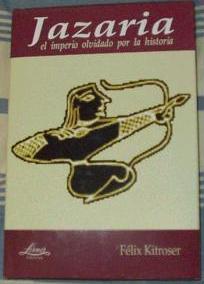 This Spanish-language book, by the prolific Argentinian writer
Félix Kitroser (1914-2009) in collaboration with the American historian Kevin Brook, presents the
full history of the Khazars, a Turkic people who founded a
large empire in eastern Europe in the early Middle Ages. Khazaria was an
economic and cultural superpower which was connected to several important
trade routes and was one of the largest-sized political formations of its
time. Khazaria was the only nation in its region with a permanent
standing army. It was also notable for its religious tolerance and its
supreme court which had judges representing multiple religions.
This Spanish-language book, by the prolific Argentinian writer
Félix Kitroser (1914-2009) in collaboration with the American historian Kevin Brook, presents the
full history of the Khazars, a Turkic people who founded a
large empire in eastern Europe in the early Middle Ages. Khazaria was an
economic and cultural superpower which was connected to several important
trade routes and was one of the largest-sized political formations of its
time. Khazaria was the only nation in its region with a permanent
standing army. It was also notable for its religious tolerance and its
supreme court which had judges representing multiple religions.
In the 9th century, many of the Khazars converted to Judaism. Jewish
life flourished in the Khazar towns of Atil, Samandar, Samkarsh, Kerch,
Sudak, Kiev, and Sarkel. It is possible that descendants of the Khazars
can be found among some Ashkenazi Jews, Kumyks, Szekelys, and other
groups.
The fascinating history of the Khazars has been studied by many
historians and archaeologists in recent years. International scholarly
conferences on the Khazars have been held in Israel (1999) and Russia
(2002) and much new research has been published from new investigations
and archaeological discoveries. There has also been much interest among
the general public. Novels about the Khazars by Milorad Pavic, Meir
Uziel, and Marek Halter have become bestsellers. Ehud Yaari's television
documentary about the Khazars was very popular in Israel. The Khazars
have been discussed in major international media including La
Nación (Argentina), Le Monde and Sciences et
Avenir (France), and the Jerusalem Report and Ma'ariv
(Israel).
Kitroser presents the latest discoveries and theories about Khazaria
in an easy-to-understand way. The book includes color maps of Khazaria by
Richard Burd and many illustrations of Khazar artifacts - including the
Moses Jewish Khazar Coin found in Gotland in 2002. It also contains
translations of the letters exchanged between King Joseph of Khazaria and
Hasdai ibn Shaprut, a diplomat of the caliphate of Cordoba in Spain, and
of the Schechter Letter, an account of Khazar history and politics by an
anonymous Khazarian Jew.
Este libro del destacado escritor argentino Félix Kitroser, con
la entusiasta colaboración del historiador norteamericano Kevin Brook, relata la
historia completa de los Jázaros, un pueblo Turco que fundó
un gran
imperio en el este de Europa durante el Medioevo. JAZARIA fue un estado
poderoso y pujante, tanto por su alto desarrollo cultural como por el
gran impulso económico, conectado con las principales rutas
comerciales de su época, que lo llevaron a ser una de las mayores
formaciones políticas del Medioevo. Fue también la
única nación
que en esos tiempos
mantenía un ejército permanente y merece ser destacado por
su amplia
tolerancia religiosa, hasta el punto de tener en su Corte Suprema de
Justicia, jueces que representaban las múltiples religiones de sus
súbditos.
En el siglo IX, buena parte de la población de Jazaria se
convirtió al
Judaísmo. La vida judía floreció en las ciudades
Jázaras de Atil,
Samandar, Samkarsh, Kerch, Sudak, Kiev y Sarkel, y es posible que puedan
encontrarse descendientes de los Jázaros entre algunos
Judíos Askenazis, Kumyks, Szekelis y otros grupos humanos actuales.
La fascinante historia de los Jázaros ha sido recientemente
estudiada por numerosos historiadores y arqueólogos. Se han
realizado
conferencias internacionales en Israel (1999) y Rusia (2002) y se han
publicado muchos de los resultados de las nuevas investigaciones y
descrubrimientos arqueológicos. El tema ha despertado,
además, gran
interés entre el público en general. Varios escritores han
publicado
novelas sobre los Jázaros, que se convirtieron en "best sellers"
como las de Milorad Pavich, Meir Uziel y Marek Halter. La serie documentaria
televisiva de Ehud Yaari sobre los Jázaros fue muy popular en
Israel. La
historia de Jazaria ha sido discutida en los mejores periódicos
internacionales, incluyendo el periódico La Nación
(Argentina), Le Monde
y Sciences et Avenir (Francia), Jerusalem Report y Ma'ariv (Israel), entre
otros.
Este libro contiene informes de los últimos descubrimientos
arqueológicos, ilustraciones de productos de Jazaria y las
traducciones
de la correspondencia entre el rey José de Jazaria y el canciller
del califato de Andalucía, Hasdai ibn Shaprut. Presenta,
además, los mapas
de Jazaria diseñados por el geógrafo norteamericano Richard
Burd. Es,
sin duda, una buena introducción para el conocimiento de este
pueblo
fascinante y en un tiempo, enigmático.
HOW TO ORDER "JAZARIA"
After I took a long break due to the COVID pandemic, I will consider selling copies again, mainly during the months of April through November.
To order this book, email Kevin Brook at
 with the subject "Jazaria".
You must be a resident of the continental United States, excluding Connecticut.
$18.00 plus shipping via the U.S. Postal Service's Media Mail Rate.
At this time, payment via PayPal would be preferable but I can also accept a check drawn on U.S. funds, or by a postal money order, or by a credit union money order.
Pre-payment is required for all orders.
Contact me first to discuss.
with the subject "Jazaria".
You must be a resident of the continental United States, excluding Connecticut.
$18.00 plus shipping via the U.S. Postal Service's Media Mail Rate.
At this time, payment via PayPal would be preferable but I can also accept a check drawn on U.S. funds, or by a postal money order, or by a credit union money order.
Pre-payment is required for all orders.
Contact me first to discuss.
Khazaria.com Homepage
