




The investigation of this site started in 2000. The excavations of the first mound revealed a burial of rather a rare type dated to the 5th-4th centuries B.C.E. The following artifacts were found there: a bronze cauldron, a brazier, various arrowheads, pottery, as well as some horse harness details of a Scythian beast style. These molded bronze heads and figures of beasts are genuine pieces of antique art.
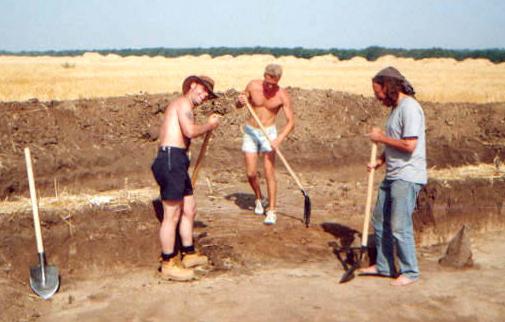
In the next year (2001), the excavations were continued by the Don Complex Archaeological Expedition. It consisted of two groups: a group of students from Rostov State University (headed by Professor V. Ye. Maksimenko) and an international group of volunteers (headed by the editor of "Donskaya Arkheologiya" journal Vladimir Klyutchnikov).
The 2001 expedition excavated 6 mounds. Three of them happened to be Khazarian mounds. One was from the Scythian era (4th century B.C.E.), and two of them were Polovtsian (Kipchak) mounds.
Here are short descriptions of the three Khazarian mounds:
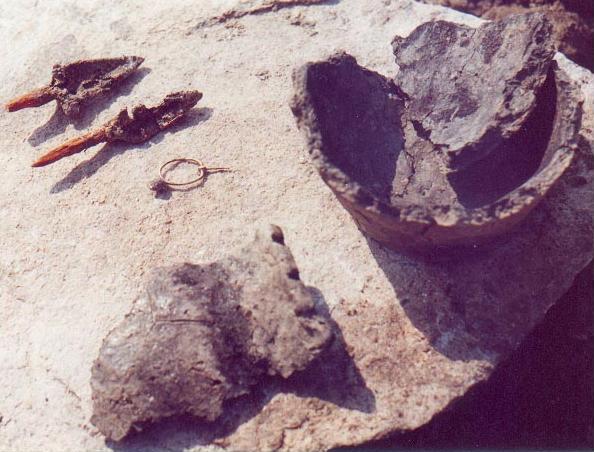
Khazarian Mound 9: Excavated by the student group. Was robbed in the past. Very few human bones. A golden earring, some pieces of ceramics, and two arrow-heads were found.
Photos:
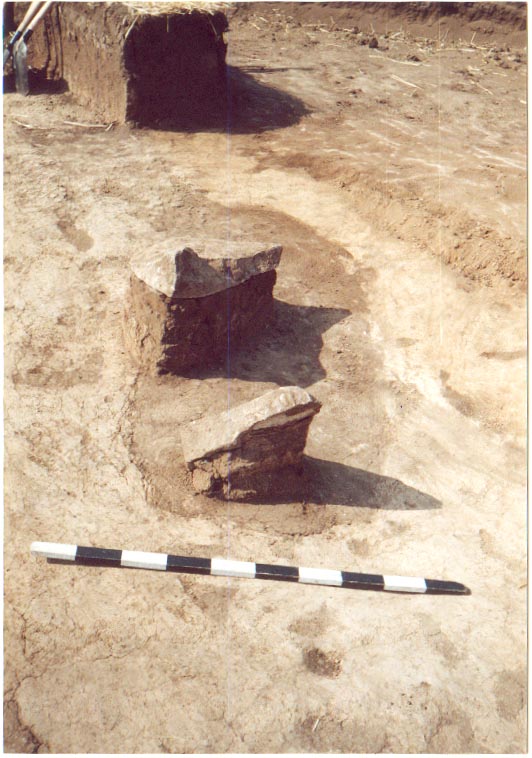
Khazarian Mound 3: Excavated by the international group. Was surrounded by a ritual ditch. Was robbed in the past. The human and the animal bones were mixed by the robbers. The human skeleton was a male 25-35 years old. Three bronze pendants of a belt were found, as well as pieces of rusty iron.
Photos:
Khazarian Mound 2: Excavated by the international group. Was surrounded by a ritual ditch. The human and animal bones were mixed by robbers. However, it was determined that the human skeleton was that of a 35-40 year old male. The silver pendant of a belt, a small golden plate in the mouth of a skull, the bone facings of a bow, pieces of rusty iron, and an iron stirrup were found.
Photos:
In 2002, no Khazar burials were found at Chastiye Kurgany among the 5 mounds excavated. Some of those which were located in 2002 were Bronze Age sanctuaries. A damaged stone carving was also located. In 2003, two additional mounds were excavated; both were from the Early Bronze Age and not connected to the Khazar era.
In 2004, from July 18 to August 8, the international expedition continued its work. The international group found an 11th-13th century Kipchak-era sanctuary on top of a 4th century B.C.E. Sarmatian mound; this obviously had nothing to do with Khazars. Meanwhile, the student group found a mound dating from the second half of the 3rd millennium B.C.E. as well as some secondary burials from the 2nd millennium B.C.E. More relevantly for this page, the student group excavated a fourth Khazar mound that was discovered a kilometer from the expeditionary camp. The book Khazary that Vladimir Klyutchnikov co-authored with Olga Kolobova and Valeriy Ivanov (who wrote together under the combined pseudonym "Oleg Ivik") was published by Lomonosov in 2012 (with a copyright year of 2013) in the Russian language. This book contains a description of the Khazar mound unearthed in 2004, translated below:
"Under this mound, in two separate graves, two Khazar warriors were buried
- perhaps they both fell in battle. The cause of death could not be
determined by anthropologists, but the bones preserved many traces of
wounds, not definitively deadly in nature but certainly attesting to a
fast-paced military past. This mound, of course, was robbed in antiquity,
but the thieves did not know that there were two deceased people. They dug a
hole then stumbled upon one of the graves and scattered it, pulling out
everything they could find. Traces of the manhole, prominent for many
centuries, were rescued from a new mound robbery - no one had had the idea
to dig into it again.
But archaeologists are distinguished from treasure hunters in that they
are interested not so much in obtaining wealth, but in how much
information can be obtained, and to some extent it can be obtained from
the already-plundered barrow: it happens that crock can bring science a
greater benefit than another 'batch' of golden decorations.
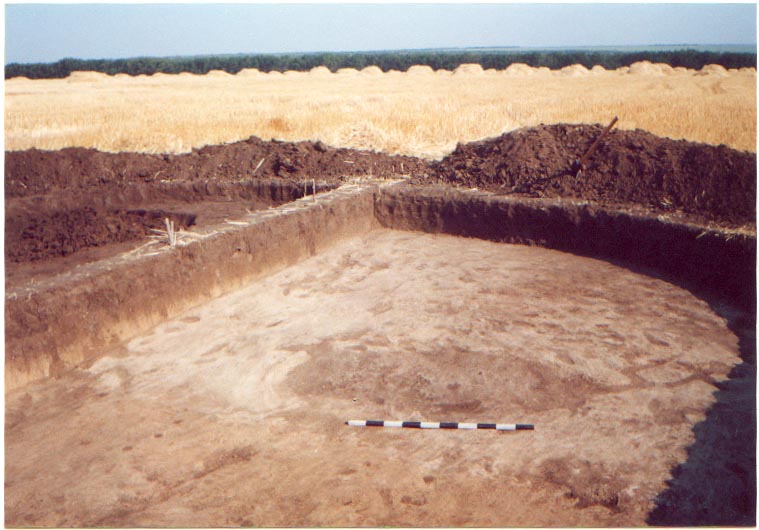
Our expedition took up the excavation of the mound and was rewarded
handsomely: when the mound was removed to the mainland, to the stripped
red clay were clearly visible surrounded by a common trench two dark spots
- two graves. One of them was not disturbed.
However, the opening of the plundered graves also yielded excellent
results: Marauders had come through here in ancient times, but after many
years or even centuries after the funeral. By this time the belt that's
worn by the deceased had completely rotted and silver findings had
crumbled. What exactly the robbers could carry is unknown, but in a pile
of bones (the body at the time of robbery had had time to decompose, and
the thieves destroyed the skeleton) archaeologists found gorgeous silver
buckles, brackets, a lugs belt, a jewelry belt purse... Also, here lay
bony plates on a bow.
The second tomb was the completely preserved burial of a Khazar warrior.
He was lying on his back near the remains of his horse - the horse was a
traditional Khazarian companion in the afterlife, but the grave is usually
only laid his head, front and back legs, covered with skin, and a full
harness set: saddle, bridle and cheek-pieces, stirrups, different kinds of
badges and decorations... All this was discovered by the archaeologists.
The warrior was armed with a club, a bow, and an arrow. Of course, only
bone lining survived from the bow, and only arrowtips survived from the
arrows. Little remained from the iron knife, but the archaeologists were
able to piece together the rust to enable them to know some semblance of
its form. But his accessories and jewelry were superbly preserved - and
the military, and the horse. In the grave lay a variety of badges, buckles,
and plates of bronze and silver, including a traditional belt set. The
Khazar was wearing on his finger a silver ring with inset stone (or
perhaps a glass paste). At his head a rough stucco vessel that had once
contained the funeral meal was clogged underground. Modern methods allow
us to extract and analyze food particles from hundreds or even thousands
of years ago to find out whether an object once held milk, grains, meat
broth, or poppy seeds, but, unfortunately, this type of analysis is still
a rarity, so the kinds of foods that 'our' Khazarian took into his final
journey remain unknown."
